“The strangest thing about this strange journey was that it was launched by a word – and not an unusually resonant one either but banal, commonplace coinage that is in wide circulation, from Cairo to Calcutta. That word is bundook, which means gun in many languages…”
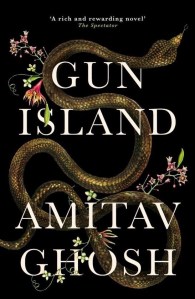
In het boek Gun Island van Amitav Ghosh, is migratie naar Europa een belangrijk thema. Migratie is evenzeer een centraal thema is grootstedelijk onderwijs. Dus aanleiding genoeg om het boek als leestip mee te geven op een blog over Urban Education.
Ik wou al lang mijn favoriete auteur, Amitav Ghosh, een plekje geven op deze blog.
In 1992 maakte ik kennis met het werk van Ghosh via een kleine boekwinkel in Mirza Ghalib Street (voorheen Free School Street) Kolkata (Calcutta, India).
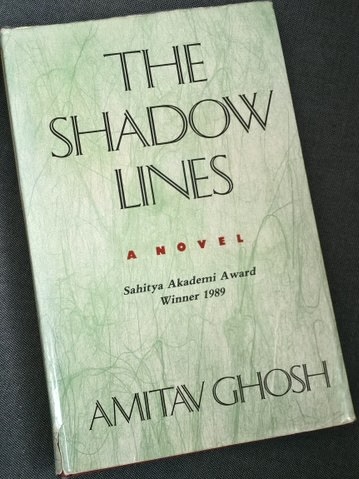
Na mijn studies deed ik een maand vrijwilligerswerk in Calcutta (Institute for Indian Mother and Child van Dr. Sujit Brahmochary) en ‘s avonds ging ik rondneuzen in bookshops nabij het Guest House waar ik verbleef. De jonge verkoper duwde me ‘The Shadow Lines’ in de handen: “You must buy this book, this is going to be a very important author.”
Ik las het boek pas enkele jaren later en was onmiddellijk gegrepen door de beeldende vertelstijl van Ghosh, het spelen met tijd en ruimte én de maatschappelijke thema’s die hij aan bod laat komen.

Gun Island, een boek van 2019, las ik pas deze zomer. Ook in dit boek slaagt Ghosh erin om actuele maatschappelijke thema’s te integreren in een boeiend verhaal dat zich permanent verplaatst in tijd en ruimte…
Ik deel hier enkele fragmenten over migratie uit hoofdstuk ‘Crossings’:
“Where d’you think they learn that they need a better life? From their phones of course. That’s where they see pictures of other countries; they see stuff on social media, posted by neighbours who’ve already made the journey.”
“Then one night the truck stopped at a connection house in a place that looked like a desert. They told us that we were close to the Pakistan border but if we wanted to go any further we would need to arrange for an extra payment of fifty US dollars each.”
“After a few days some Kurdish men came and loaded us into a truck that was covered with tarpaulin. We were told that when the truck stopped we would have to run as fast we could. They warned us that if we were spotted by Turkish border guards they would open fire. If we managed to make it over then we would be met by guides, on the other side.”
“Tipu told me that I should get off the bus at a town near Istanbul and join a group of refugees who were planning to walk to Europe. Following his advice I joined the refugees – there were a few Bengalis among them, but the others were from Iraq, Syria, Afghanistan, Somalia, Pakistan and some other countries too. I followed them over the border into Bulgaria, and then on through Serbia, into Hungary and Austria.”
“In Austria I took a train that brought me to Italy where I was entered into a Centro di accoglienza near Trieste. After a few days I was moved to a camp outside the city.”
Naast migratie van mensen en dieren, gaat Gun Island ook over de klimaatverandering, vrouwen als motor voor verandering, kracht van taal en meertaligheid, de verwevenheid van heden en verleden,… én de samenhang van dit alles.
We’re in a new world now. No one knows where they belong any more, neither humans nor animals. – Gun Island, Amitav Ghosh
***
Ik las ondertussen al heel wat romans van Ghosh:
- The Shadow Lines (1988)
- The Calcutta Chromosome (1995)
- The Glass Palace (2000)
- The Hungry Tide (2004)
- Sea of Poppies (2008)
- River of Smoke (2011)
- Flood of Fire (2015)
- Gun Island (2019)
Amitav Ghosh schreef ook belangrijke non-fictie, o.a. over de klimaatverandering:
- The Great Derangement: Climate Change and the Unthinkable (2016)
- The Nutmeg’s Curse: Parables for a Planet in Crisis (2021)
Subscribe blog Urban Education
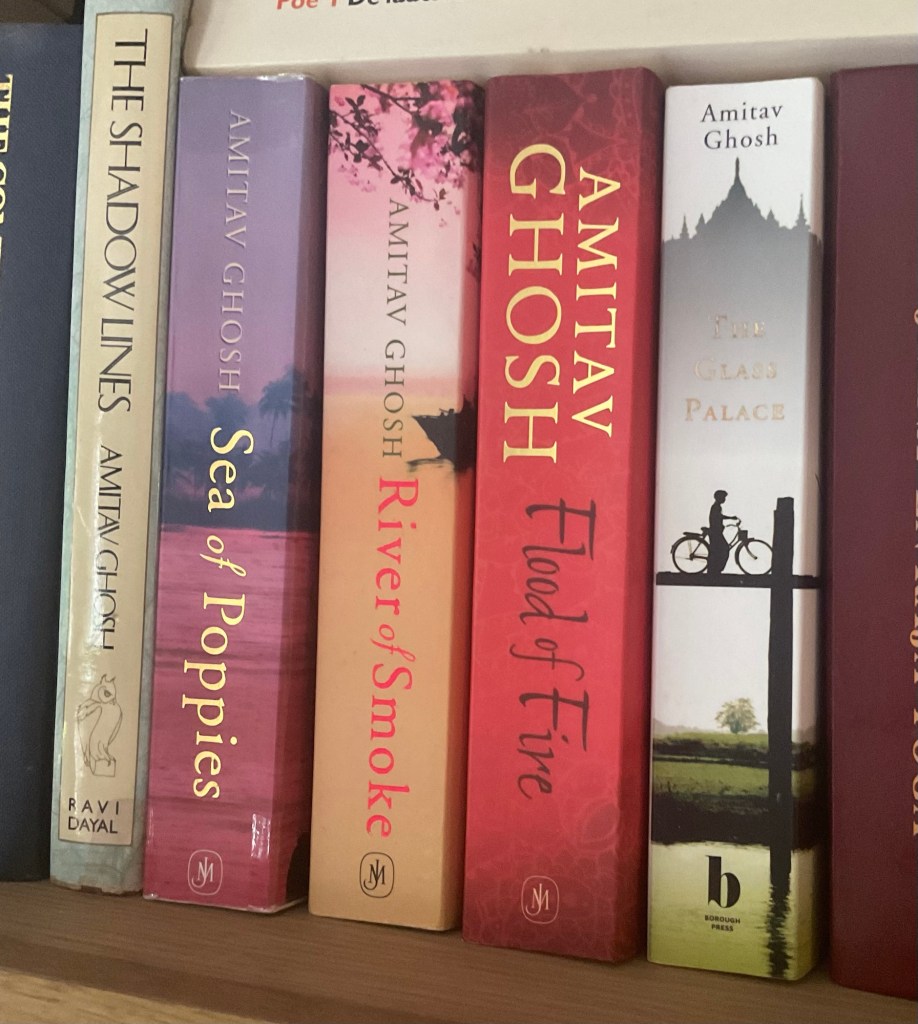
The Ibis trilogy on my bookshelf: Sea of Poppies (2008), River of Smoke (2011), Flood of Fire (2015)
 Urban Education
Eén opmerking over '“No one knows where they belong any more, neither humans nor animals” (leestip)'